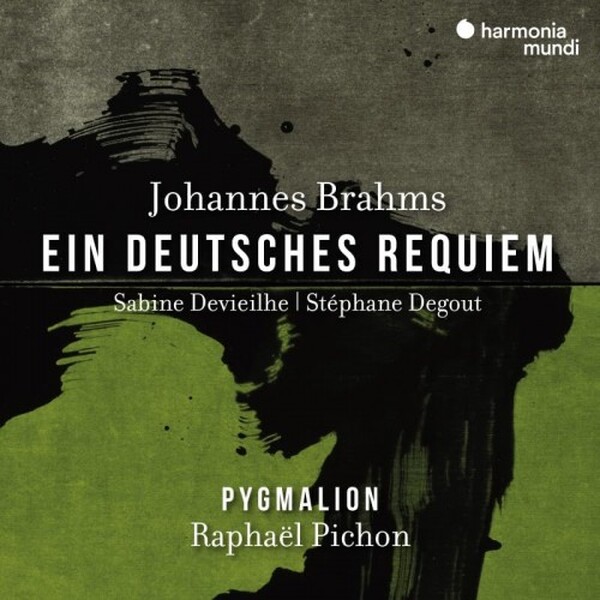
Brahms - Ein deutsches Requiem | Harmonia Mundi HMM932772

Brahms - Ein deutsches Requiem

£17.05 £16.10

save £0.95 (6%)

special offer ending 30/01/2026

In stock - available for despatch within 1 working day

Label: Harmonia Mundi

Cat No: HMM932772

Format: CD

Number of Discs: 1

Genre: Vocal/Choral

Release Date: 12th December 2025

Contents

Artists

Sabine Devieilhe (soprano)
Stephane Degout (baritone)
Pygmalion

Conductor

Raphael Pichon

Works

Brahms, Johannes

Ein deutsches Requiem (A German Requiem), op.45

Artists

Sabine Devieilhe (soprano)
Stephane Degout (baritone)
Pygmalion

Conductor

Raphael Pichon

About

*** Digipack version of HMM902772 ***

A world removed from the grand and awesome visions of the Last Judgement that so often characterise settings of the Mass for the Dead, Brahms conceived a work of ‘consolation for those who are suffering’.

Having spent more than ten years absorbing this German ‘humanist’ Requiem, this album’s performers have meticulously shaped every bar of this compact work, achieving a form of polyphonic transparency that confounds the senses and transcends the universality of its message.

Europadisc Review

Raphaël Pichon and his Pygmalion ensemble are still riding high from the critical acclaim that greeted their recent recording of J.S. Bach’s B minor Mass (and, three years prior to that, the same composer’s St Matthew Passion). Now they turn their attention to another of the great cornerstones of the choral repertoire: Johannes Brahms’s Ein deutsches Requiem (A German Requiem). This is a work that has enjoyed a good number of outstanding recordings over the years, from Karajan’s 1947 Vienna recording and (of course) Klemperer’s legendary 1961 Philharmonia performance (both featuring soprano Elisabeth Schwarzkopf) to historically-informed accounts from the likes of Gardiner and Norrington (two recordings apiece).

With the orchestra using period instruments, and a choir of thirty-seven singers, Pichon’s new recording is in the latter camp, and there are moments of chamber-like transparency, particularly in the consolatory outer movements, the central movement ‘Wie lieblich sind deine Wohnugen’ (How lovely are thy dwellings), and the radiant soprano solo of ‘Ihr habt nun Traurigkeit’. Yet he certainly doesn’t sell the bigger movements short, and the mighty Handelian fugues that close the second, third and sixth movements are every bit as thrilling and imposing as they should be.

The German Requiem has been enjoying something of a revival on disc in the past year or so, driven, no doubt, by the appearance of the new Brahms Complete Edition of the score, edited by Michael Struck and Michael Musgrave (Henle Verlag, 2022). There’s nothing in the accompanying booklet to indicate which edition has been used by Pichon, but among the more salient details are the use of an ophicleide (rather than tuba) on the bottom line of the brass, and the omission of the optional organ part.

The first big surprise is the speed of the work’s opening: rather slower than the original marking of crotchet = 80 (subsequently withdrawn by Brahms), almost a minute longer than Gardiner (1992), and a good two minutes longer than Norrington (1992)! The contrast between the grainy and very ‘present’ sound of the middle and lower strings (every sinew of the texture straining with grief) and the remarkably hushed voices at the first choral entry, although contradicting the dynamics in the score (both are marked piano), draws the listener in, and the bigger contrast, between the more introspective outer sections and the brighter central section (‘und kommen mit Freuden...’) is well conveyed while maintaining the same steady pulse. (Special mention should be made of the outstanding woodwind ensemble playing at the varied return of the opening ‘selig sind’.)

From this captivating start, the performance steadily reveals itself as one of real musical and expressive strengths. The famous triple-time ‘funeral march’ of the second movement (‘Denn alles Fleisch, es ist wie Gras’) features some truly shattering timpani playing, accompanied by gnarling horns. At the crucial words ‘Aber des Herrn Wort bleibet in Ewigkeit’, however, the sun bursts out, the choral attack incisive without sacrificing warmth. In the third movement, Stéphane Degout’s baritone has a tremulous, vulnerable and confessional quality, which transfers to the halting orchestral accompaniment during the choral responses. After a brief moment of light (‘Ach, wie gar nichts’), the shadows return; but the transition (‘Ich hofe auf dich’) to the closing fugue over a mighty D pedal is a magical moment of revelation, the crescendo superbly handled by Pichon and his singers.

In ‘Wie lieblich sind deine Wohnugen’ it’s the care over telling detail in the movement’s latter stages that stays in the mind: the perky quavers in clarinets and cellos, and the gently nudged syncopations in the horns. The fifth movement, with its glorious soprano solo (the only time that voice is heard), was added after the work’s first performance: listening to Sabine Devieilhe’s soaring yet pure-voiced account here makes one especially grateful to Brahms for doing so. She combines lightness with the right sort of edge to cut through the textures at the music’s climax, and her handling of the text is utterly sincere.

The penultimate movement, ‘Denn wir haben hie keine bleibende Statt’, is another of those slow-burners that builds to an exultant conclusion, and here the opening textures are commendably light. Degout’s entry brings a palpable increase in tension, and the trombones that signal the Last Trump (or rather, in Luther’s German, ‘letzten Posaune’ – ‘last trombone’) are particularly imposing: the chorus that follows is thrillingly incisive, and the magnificent sequence at ‘wo ist dein Sieg?’ (Where is thy victory?) has a sweeping feeling that’s impossible to resist.

With the final chorus, ‘Selig sind die Toten’, Brahms completes the circle of this symmetrically structured work, at the same time having used a tonal scheme that gradually ascends to brighter levels. Pichon’s performance unerringly brings out these qualities, combining the best of historically-informed stylishness with penetrating insights that defy narrow categorisation. Vividly recorded in the Pierre Boulez Salle of the Philharmonie de Paris, this is a disc that no-one who’s enjoyed Pygmalion’s revelatory Bach will want to be without.

Error on this page? Let us know here

Need more information on this product? Click here